Writing

How to Stay Motivated as a Writer

Last November, freelance writer and self-described blog junkie Maria Rainer wrote an excellent guest post for The Chipper Writer, called Find Focus by Eliminating Distractions. Tomorrow, I plan to run her second guest post, “Copywriting: How to Put Your Portfolio Together.”

In the meantime, I want to post a link to another guest post Maria wrote for Dallas Woodburn’s Writing Life, because I love it. Called Staying Motivated, I read it on a day when I felt down about my writing, and it was just what I needed to start back up.

Happy Writing, and please drop by tomorrow for Maria’s guest post! Thanks!

Photo credit: stock.xchng.com

Writing Goals for 2011

At the end of my last post, I asked about writing goals for 2011. The same question was posed to me by freelance writer Kristine Meldrum Denholm, who blogs at Writing Stories of life: one writer’s odyssey. To read my answer and the writing goals of five other writers, check out her terrific post, What We Want: 6 Goals Writers Have for 2011. Feel free to share your writing goals, too, and I wish you Happy Writing this year and beyond!

Photo credit: stock.xchng.com

A Look Back: The 27th Annual Western Reserve Writers Conference & Workshop

The 27th Annual Western Reserve Writers Conference & Workshop took place on September 25 at Lakeland Community College. I participated as a presenter and a student.

Mystery writer and musician Don Bruns spoke on the importance of networking with writers and editors at conferences in his keynote address, “Writing the Stuff Dreams Are Made Of.” He also treated us to a musical tribute:

After the keynote, I attended “Mastering the Memoir,” taught by one of my favorite writers, Erin O’Brien. With Erin’s guidance, we chose an object we connected with on a personal level, and used it to extrapolate details and draw out ideas for memoirs.

Then I learned about the “Elements of a Great Personal Essay” with freelance writer and essayist Stefanie Wass. Stefanie shared the seven elements of a personal essay (notice they are found in fiction, too):

1. “Theme”

2. “Clear story structure”

3. “Setting”

4. “Dialogue”

5. “Metaphor”

6. “Musing voice” (the reader sees the narrator work things out in his or her mind)

7. “Personification”

After Stefanie talked about each element, we took a few minutes and applied them to our own essays. I enjoyed this time to jot down ideas.

After the first two workshops, we broke for lunch. The Q&A Panel followed.

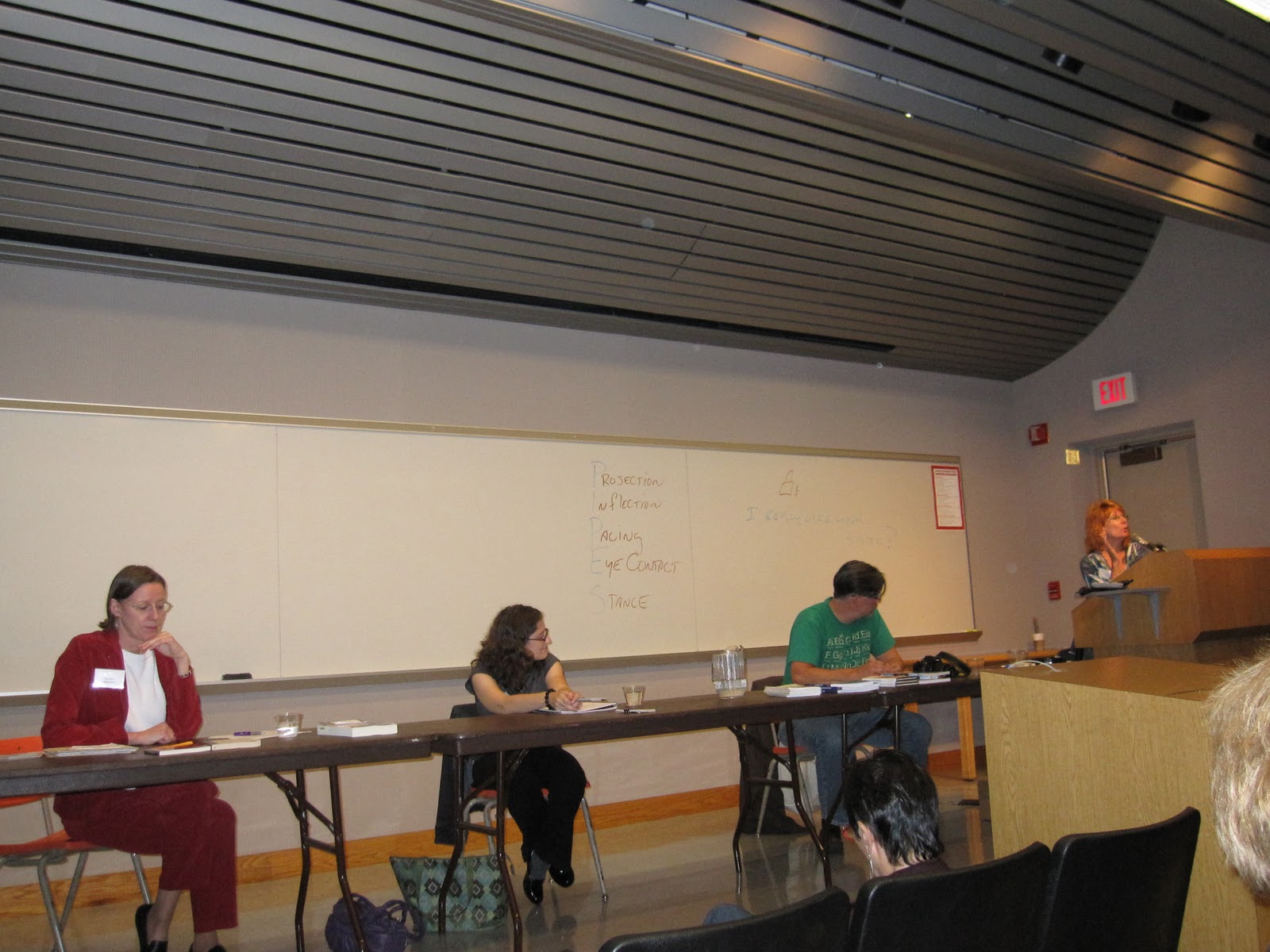
Poet Michael Salinger presented on public speaking for writers. He gave us an acronym, “PIPES”:

Projection”

Inflection”

Pacing”

Eye contact”

Stance”

The Q&A Panel (from left to right: Susanne Alexander, Alanna Klapp, Michael Salinger, & Deanna Adams)

I spoke next. My presentation, called “Jumpstart Your Writing Life,” discussed how to avoid pitfalls and procrastination, and how to organize and make the most of your writing time. I shared pointers from my award-winning essay “Overcoming Procrastination with Logs, Frogs, and Blogs” and the companion piece, “The Finer Points of Frog Eating.” I pulled tips from Jennifer Blanchard’s e-book, called Butt-In-Chair: A No-Excuses Writing Productivity Guide for Writers Who Struggle to Get Started. I also prepared a supplementary handout with resources. If you’d like one, please email me at alannaklapp@gmail.com.

Next, editor and writer Susanne Alexander talked about the self-edit. She listed nine reasons to edit your work (my favorite part of the creative process):

1. “Action” (use active not passive voice)

2. “Beckon” (readable, invites the reader in)

3. “Brighten” (descriptive words)

4. “De-Jargon” (don’t use big words to make your reader stop and get the dictionary, avoid cliches)

5. “Lighten” (you don’t always have to write serious work)

6. “Tighten” (cut words that aren’t necessary)

7. “Righten” (check pronouns)

8. “Shorten” (use a small word instead of a big word)

9. “Strengthen” (clear up vague writing)

Writer and teacher Keith Manos taught the last workshop, called “Write it Right!” This fun (yes, fun!) grammar course covered punctuation marks and how to write rhythmic sentences. He made me look at the hyphenated modifier in a new way, and after his class I found myself writing them more during practice (disclaimer: don’t overuse them, but for warm-ups they are great to loosen up your brain). An example I wrote post-conference:

“So I wasn’t going to write tonight, but the compulsive, feels-better-when-I-write-rather-than-when-I-don’t part of me said I deserved to sit down and write.”

Afterwards, Conference Coordinator and award-winning writer Deanna Adams said,  “I’m proud to continue the work of my mentor, Lea Leever Oldham, founder of the Western Reserve Writers Conference, one of the longest running writers conferences in Ohio. Because we writers spend so much time at the keyboard, we really need to get out and mingle with like-minded folks who by nature are supportive, and simply interesting people. They become our mentors, our friends, our consultants. And that’s why conferences and workshops are so necessary to writing success.”
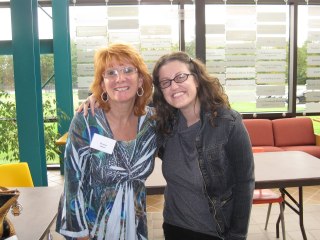

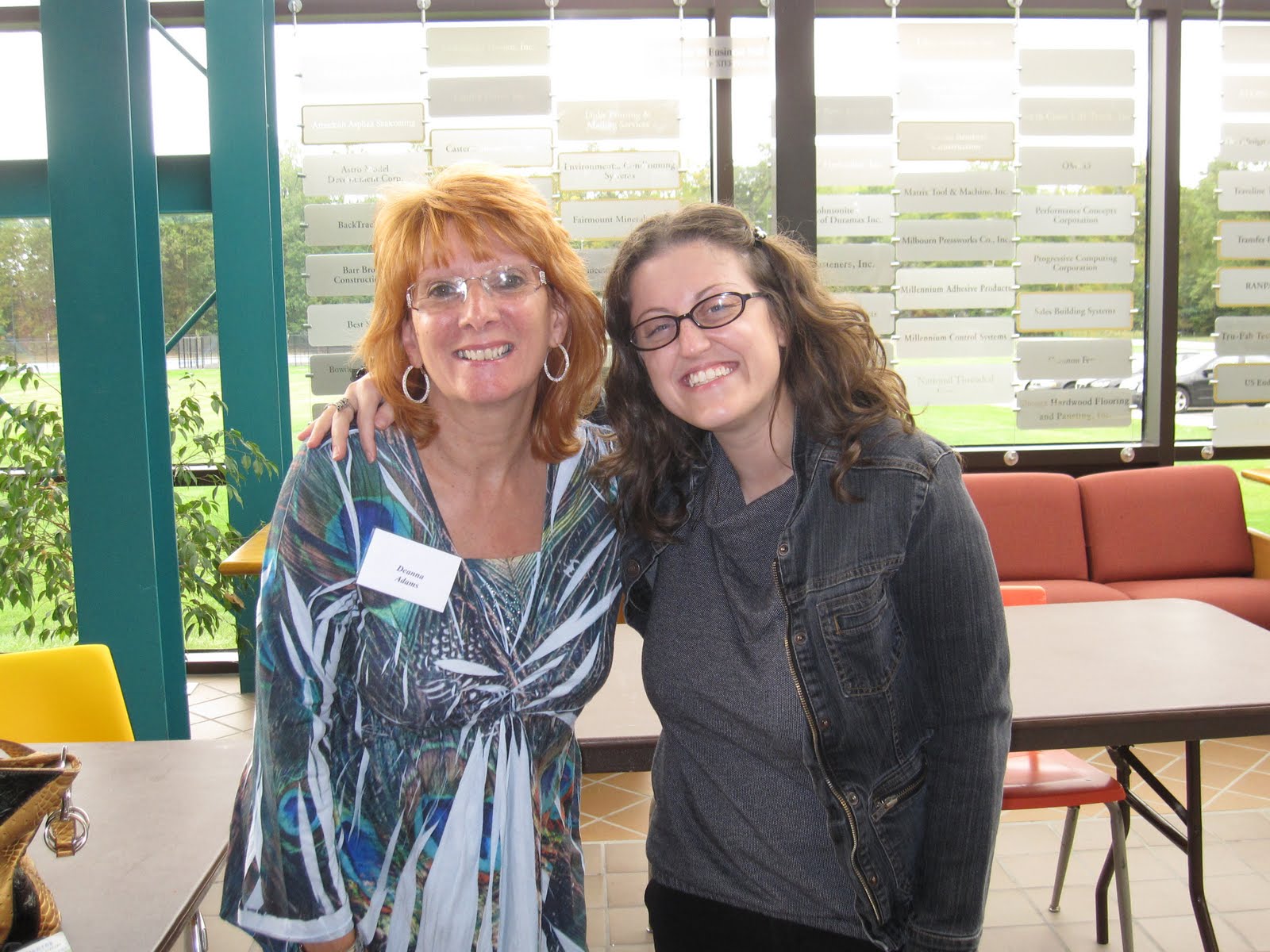
                                          Deanna & me after the conference

If this piqued your interest, save the date for the spring conference on March 26, 2011. It’s a half day instead of a full, but just as valuable, and an excellent way to ease into the world of writers conferences if you haven’t attended one yet.

I’ll leave you with a quote from novelist Thrity Umrigar. It’s from a bonus section in the back of her novel The Space Between Us, called “Words to the Wise Would-Be Writer: 15 Tips.” Here’s tip #14:

“Be gentle with yourself. Great writing is always compassionate. The same compassion you bring to your observations about the foibles of humanity, you must bring to yourself. So don’t judge yourself harshly if the writing is truly terrible on a given day or you decided to go for a walk with your daughter instead of working on your manuscript. Just get back to it the next day.”

This always applies, but I think it’s even more appropriate for this time of year, when the holidays eat into writing time.

What’s your experience with writers conferences? What techniques do you employ to make sure you get some writing time in during the holiday season? What are your writing goals for 2011?

Special thanks to Jenn for the photos and your support.

Happy New Year and Happy Writing!

The Chipper Writer’s First Blogiversary


The inspiration for this post comes from Kass, who blogs at The K………………Is No Longer Silent. In July she wrote a post called Happy Blogiversary to Me, and as soon as I read it I knew I wanted to write my own blogiversary post. A year ago today I wrote my first post, called Alanna Klapp’s Four Guest Host Podcasts in 2009.

In the spirit of my first blogiversary, I thought I’d write a recap of my two guest host podcasts for The Writing Show in 2010.


1. Writing Flash Fiction, with Michael Wilson, posted on March 21

Michael Wilson is the author of Flash Writing: How to Write, Revise and Publish Stories Less Than 1000 Words Long. He is also the creator of the JumpStart Jar.


2. A Conversation with Sarah Willis, posted on September 5

Sarah Willis is the author of four novels: Some Things That Stay, The Rehearsal, A Good Distance, and The Sound of Us.

I appreciate you dropping by to help me celebrate my first blogiversary. I’ve had so much fun blogging and meeting other bloggers. Despite some long gaps between posts (and the two month hiatus I took after the death of my beloved Aunt Joni, when I didn’t write much), I’m happy to say I’ve stuck with it for a year. It’s a huge milestone in my journey as a writer. The blog has truly helped me to log some writing hours. Thank you, readers, for giving this blog a reason to exist.

My focus for 2011 will be to make this more of a writing-oriented blog. A special interview series with writers for writers is in the works. I’m exploring in-depth the concept of flow and how to create it while you write, and I plan to post my findings and insights. I’m also working with other bloggers on upcoming guest posts with valuable info for writers (if you missed them check out Three Ways Social Networking Can Increase Book Sales by Angelita Williams and Find Focus by Eliminating Distractions by Maria Rainier). I’m planning on the occasional non-writing post, more book reviews, and of course some football thrown in.

My question to you: what kind of writing topics or other subjects would you like to see posted on The Chipper Writer?

Happy Writing and Happy Holidays from The Chipper Writer, and thanks again for reading!

Cupcake photo credit: stock.xchng.com

Find Focus by Eliminating Distractions


Guest post by Maria Rainier

Full-time writers and those burning the midnight oil typing away at novels-to-be after long days at the office have a common enemy: distractions. They’re everywhere, and that’s no horror film hyperbole.

Whether you rely on your writing income to feed the kids or you have a story worth telling even if it means “working” after work, writing while distracted is an enormous waste of time. The right words don’t come to you, the sentences aren’t formed right, and they don’t flow one after another. I’ve sat across from my laptop for three hours and literally written one sentence (and then erased it an hour later).

We all work differently. Some of us can write on the train ride to work; others need absolute silence and solitude to function. Regardless of where you stand, keep these points in mind.

Have a Schedule

Some writers assert they don’t need one. If you’re a freelance writer and say you don’t need one, however, you also fool yourself. With a schedule, you can keep assignments in check as well as set aside a visual reminder for various tasks. Perhaps most importantly, with a schedule, you can dictate when you’re working and when you’re not. Remember, there’s no gray area. If you’re writing, focus on writing and on nothing else. Sticking to said schedule can be tough, but remember that it’s your own writing that suffers if you stray from the promises you make to yourself.

Give Yourself Space

Take a look at your workspace. Mine has a candle warmer, a framed photograph of my significant other, a few Italian and Japanese books, an old sweater I should probably throw in the washer, insurance papers, a broken necklace I need to fix, broken sunglasses missing a screw, and the AVID Friend Chip pet microchip brochure I need to fill out for my recently rescued mutt. These are all reminders of non-writing related things I need to do, things that could (and most days do) distract me from writing during designated writing hours.

Clear your desk. Find a bookcase for books, folders for documents, and a to-do box for to-dos—and put them under your desk or otherwise away from your workspace. It’s unfair to ask yourself to keep all these things in mind while writing, too.

Demarcate Writing from Everything Else

This can be difficult for people like me. I’m both a freelance writer as well as an aspiring fiction writer. When doing the former, I use the same desk with the same calendar, same candle, same cup of coffee, same books as I do when I’m writing fiction. Distinguishing when I write for pleasure and when I feel like I can squeeze in one more assignment for a bit more pay can be difficult. Distinguishing when I write at all and when I want to see what my friends are up to on Facebook or what’s going on in the world of television and movies can be even more difficult.

The Internet is probably the freelance writer’s strongest friend and most treacherous enemy, especially if you work from the same computer. I recently learned this lesson the hard way; because I Facebooked intermittently during work hours, my family and friends assumed I had an easy job from which I could take time off to socialize or help them with household chores. Soon, my mother-in-law was calling me to help her let the dogs out of their rooms or to water the plants while she was gone, and my friends overseas complained when I wouldn’t Skype with them in the middle of the day.

If you find yourself Facebooking or web-browsing often during designated writing hours, try using a different browser just for writing. Don’t include any social networks or leisure-related sites to your favorites list. Use another browser for leisure sites and keep this one off your desktop.

Stick with your schedule and write a certain number of hours a day, using those hours only to write. After hours, do with your time what you like, be it Facebook or YouTube, guilt-free. Motivation is hard to come by, anyway—why fight for it? Instead, give yourself the opportunity to write when you need to write, work when you need to work, and play when you need to play.

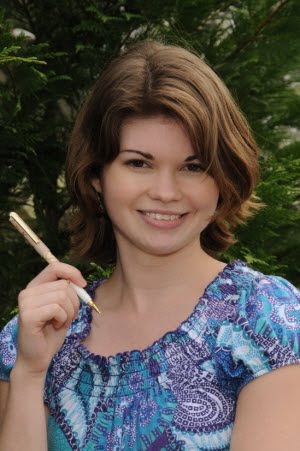
Bio: Maria Rainier is a freelance writer and blog junkie. She is currently a resident blogger at First in Education performing research surrounding online universities and their various program offerings. In her spare time, she enjoys square-foot gardening, swimming, and avoiding her laptop.

The Chipper Writer Listed in The Written Connection


I’m pleased to tell you The Chipper Writer is now listed in a directory of writers blogs called The Written Connection. A.M. Kuska, the owner of The Written Connection, gave my blog a nice review and interviewed me, all of which can be read here.

The goal of The Written Connection is “to make it easy for writers to find other writing related blogs, and their voice to be heard as well.” Below are links to a few of the other writers blogs listed in the directory, and I recommend looking at them all.

Writing. Family. Life.
Author: EK Carmel

Write For Me

Author: Hallie Sawyer

Miss Rosemary’s Novel Ideas
Author: Rosemary O’Connor

Tales from the Writing Front
Author: Dara Sorenson

A Writer of Wrongs
Author: Terry Towery

If you’d like your writing blog to be considered for the directory, or if you’d like to recommend one, please email The Written Connection at sskid2000@hotmail.com.

What are some of your favorite writing blogs? Please share!

Photo Credit: Blogging Research Wordle by Kristina B on Flickr

Three Ways Social Networking Can Increase Book Sales


This is the first guest post for The Chipper Writer, contributed by Angelita Williams.

While social media networking sites such as Facebook and Twitter can keep you connected with friends and family, they can also serve as excellent marketing tools for writers trying to promote their latest project. But it takes more than just creating a profile or fan page to keep the momentum and your number of readers up. Here are 3 tips to utilize networking sites properly and increase book sales.

Create a fan base. This might be the hardest part for new and upcoming writers. The key thing to remember is that you need to build a connection with your readers/fans so that you can prove later on to your publisher that you actually have them. Knowing fan base numbers may become beneficial when you want to get the green light on your next project. Creating a fan base can be accomplished in several different ways.

1) Responding to selected tweets/wall post every now and then. This shows your readers that you do care what they have to say and that you personally participate in your page. Fans prefer it when the writers themselves monitor their pages as opposed to a publisher. Take note that it’s not all about you either, meaning don’t only respond to things regarding you. Commenting on fans’ and other writers’ statuses/tweets that interest you is also encouraged.

2) Another way build a fan base is to create scheduled forums or “chat times.” For example, make a post saying, “From 3 to 4 p.m. I’ll answer any question written on my wall or tweeted to me.” Or, “Today from 3 to 4p.m. I will be having a forum discussing my latest book.” Readers will get to know you better and you’ll get to know your readers better as well. It’s important to note that some readers/fans may use this opportunity to criticize you, and it’s important not to respond rudely when/if they do.

Use all of the site’s applications. Whether it be videos, photos, or the events applications, make sure you use all of what the site has to offer to its maximum potential. Change your profile picture to be somewhat related to your project, for instance, the cover of your book if it is available. Use the events section to invite fans to promotional events such as book releases. Use your Facebook status and tweet updates as teasers like a line from your book, or the release date. You can also use your statuses/tweets to get ideas from your fans. You can post questions like, “Do you like this idea?” or, “I need a good name for this character, any suggestions?” Anything that can keep your fans interacting is best.

Previews/Trailers: Hollywood uses them to promote up and coming films, why not create them for your book to give your readers a little taste of what’s to come? This can be accomplished numerous ways. One way is to post a video of yourself reading a section of your book out loud accompanied with images or music that sets the theme of your book. This is an excellent way to plug your book. It will ultimately leave your readers wanting the whole thing. Whatever you choose to do, make it creative and make sure that it will leave your audience wanting to buy the book. To make sure that your fans see it and don’t pass it up accidentally on their mini feeds on Facebook, you can send the video in a mass private message.

By-line:
This guest post is contributed by Angelita Williams, who writes on the topic of online college courses. She welcomes your comments at her email Id: angelita.williams7 @gmail.com.

A Conversation with Novelist Sarah Willis & Brian Martin’s Community Short Story Project


Greetings, dear readers. I have two writing-related tidbits to share with you:

1. My latest interview for The Writing Show, A Conversation with Sarah Willis, is now available for download here. Sarah Willis is the author of four novels: Some Things That Stay, The Rehearsal, A Good Distance, and The Sound of Us. I spoke with Sarah about her books and the writer’s life.

2. Over at The Writing Show, Brian Martin’s Community Short Story Project is well underway, but there’s still plenty of time for you to participate and win some great prizes. If your story is selected as a winner, you have your choice of the following prizes:

-an appearance on The Writing Show

-a 750-word critique of a first chapter from Paula B.

-a perfect-bound paperback from the Espresso Book Machine at the McMaster University bookstore

-a copy of Maralys Wills’ inspiring book Damn the Rejections, Full Speed Ahead: The Bumpy Road to Getting Published

-help with a query letter from Paula B.

Round 3 submissions will be accepted until October 2. Voting for Round 3 will take place October 3-9, and the winner announced on October 10.

To learn more, read the write-up on The Writing Show’s Web site, and get into The Writing Show Forum to participate. Once in the forum categories, click on Brian Martin’s Community Short Story Project.

Happy writing from The Chipper Writer!

New Guest Post for Procrastinating Writers


What is flow and how is it created? You can read the answer in my new guest post for the Procrastinating Writers Blog, called Time Warp: 5 Ways to Find Flow in Your Writing.

If you missed them, here are my two other pieces posted on Jennifer Blanchard’s blog that “offers guidance for writers who struggle to get started”:

My second place essay for the Procrastinating Writers Blog essay contest:
Logs, Frogs, & Blogs

The companion article to the essay:
The Finer Points of Frog Eating

Also, a reminder….the 27th Annual Western Reserve Writers Conference and Workshop is two weeks from today on September 25. There’s still time to register here.

Happy Writing from The Chipper Writer!

Photo credit: Day 79 – focus by margolove on Flickr

27th Annual Western Reserve Writers Conference & Workshop

You may recall my post last March about the 19th Annual Western Reserve Spring Writers Conference. The fall counterpart, the 27th Annual Western Reserve Writers Conference and Workshop, will take place at Lakeland Community College (Kirtland, OH) on September 25 from 8:30 AM to 4:00 PM.

I’m pleased to tell you I’ll be a presenter on the Q & A Panel this year. My presentation is called “Jumpstart Your Writing Life”. I’ll discuss how to avoid pitfalls and procrastination, and how to organize and make the most of your writing time.

Erin O’Brien will host a workshop called “Mastering the Memoir” and John Ettorre will talk about “Social Networking? There’s a Better Way.” Conference Coordinator Deanna Adams will hold a workshop titled “About Book Proposals and the Novel Synopsis.”

The cost of the conference is $95 (which includes lunch if you register by September 10th), and for an additional fee of $10, you can sign up for a prearranged editing session with Nancy Piazza, Elizabeth Irwin, or Jo Gibson. For more information, including a complete list of workshops, the bios of all the presenters and editors, and to register, please click here. I’d love to see you there!

If you can’t make it to the conference (or if you can) but would still like to learn some valuable writing advice from Erin O’Brien and/or Deanna Adams, you can download and listen to my interviews with them on The Writing Show. I spoke with Erin about fiction and nonfiction writing, and Deanna about memoir.

The Importance of Detail, with Erin O’Brien

Writing Memoir, with Deanna Adams

The main pitfall I encounter is procrastination, which I have to battle every day in order to get words down. The focus of my talk at Lakeland will be on how to overcome procrastination and organize writing time. I’m curious though, from my fellow writers and bloggers, what other difficulties do you face and what do you do to defeat them so you can write?

Thanks for reading, happy writing, and I do hope to see you at the conference!