A Beauty Tip to Relieve Dry Cracked Hands

If you’re anything like me, you live in the north somewhere where it snows and it’s cold, and your hands have taken a beating by this time in February: cracked, sandpapery, and painful.

I love Neutrogena Norwegian Formula hand cream, but unless I put it on in microscopic bits, it’s very greasy, which makes me not want to put it on, which makes the skin on my hands suffer even more.

My husband came up with an excellent tip to use this lotion. My hands are irritated but his have taken a much more brutal beating this winter. He’s a plumber and has cracks on his thumbs and finger joints that are deep and bleed.

Below is his method. I have personally tried it, and testify that it works.

1. Dampen your hands slightly with water. I know, this is probably the last thing you want to do when your skin is so dry, but it works. Do not run them under running water, just put a few drops in your palm and run your hands together so the palms and the backs are moistened, not soaked.

2. Apply the Neutorgena Norwegian Formula hand cream. Rub it all over your hands, into your fingers, in the spots you need relief the most (for me it’s the knuckles on my index fingers). The lotion should lather like soap. If you have time, let it sit on your skin for a few minutes (soooo soothing!!).

3. Take a paper towel and gently wipe the cream off your hands. The result is smoother, softer skin that’s not greasy, and you can immediately carry on.

It’s amazing! So glad my husband told me and so I wanted to share it with you.

4 Tips for Starting a Writers Group


Guest post by Heather Green


A writers group is one of the best ways to improve your writing and get feedback on your story before you attempt publication. However, not all writers groups are as successful as others. It’s important you carefully consider your ultimate goals in writing and your writing style when forming a group. It’s also crucial to set clear guidelines and rules to make the group work more effectively. Here are four tips to get you started.
Determine the Purpose of the Group
It helps to be in a group with like-minded writers. Some writers groups will focus primarily on writing for the sake of writing, and many members do not intend to pursue serious publication. Other groups are more focused on publication and may take the craft of writing a marketable novel more seriously. Both types of groups are valid and work well. You may also have a mix in your group. As you become more serious about writing, you may gravitate towards a group that is more focused on publishing.
Decide on the Type of Writing for the Group
Some mixed groups work well, but it can be difficult for someone who writes children’s books to get effective feedback from someone who is focused on writing mysteries. Both types of writing are of equal value, but they take a very different approach. Some crossovers will work better than others. For example, you can often combine people who write young adult books with middle grade books or across genres within the same age group. Similarly, young adult romance authors and adult romance authors may be able to help each other in a writing group. Nonfiction writers may work better with a group focused on nonfiction.
Set a Schedule
Setting up a schedule will make it easier for the group to function properly. You can determine how often you meet and the amount of work each group member submits. If you meet each week, you may have members rotate when they submit, or you may require a set number of pages from each member each week. You’ll need to limit the size of the group so you can effectively critique each person. The schedule is paramount to making the group work. It’s important to have consistent meeting times, and to have someone who will control that aspect of the group.
Another slice of the schedule may include focusing on a certain aspect of writing. You may assign a different group member to give a presentation on a writing skill, tip or trick each meeting, followed by an assignment or exercise. This can help each writer improve and look for specific areas to work on each week.
Critiquing Guidelines
Another critical group feature is to set up clear guidelines when it comes to providing critiques. If you are meeting as a group, it helps to have the material beforehand so everyone can read it over a few times and offer more meaningful suggestions. If you’re not comfortable doing that, have each writer provide a paper copy at the critique group so members can write comments on the paper.
Critiquing guidelines need to address critiquing etiquette. It’s essential you provide meaningful feedback without being malicious or totally tearing something apart. It helps to find some specific things to praise as well as specific things to work on.
About the Author:
Heather Green is a freelance writer for several regional magazines in North Carolina as well as a resident blogger for onlinenursingdegrees.org. Her writing experience includes fashion, business, health, agriculture and a wide range of other topics. Heather has just completed research on online nursing programs and associates in nursing.

Three Ways Writers Can Earn Credibility Online

Guest post by Angelita Williams


So you’ve written a novel that’s sure to revolutionize the way society thinks. One small problem: no one knows who you are. How will consumers know your book is worth a shot if you don’t have much credibility under your belt? While credibility is typically earned over time, there are some ways you can try to build momentum online—or at the very least add some new material to your About Author page.
Enter a Writing Contest
 
You may have entered a few writing contests in high school, but there are still a plethora of opportunities for adult writers roaming around in cyberspace. While some contests require a small fee, others are completely free to enter (and please beware of scams!). Just about all genres are available, including fiction, nonfiction and poetry. To find national or local writing contests in your area, just do a simple Google search, scour blogs or join a writer’s forum. If you win, you can definitely use this accomplishment to help self-promote and get you noticed by publishers— you can also use the cash prize to help self-publish, market future projects, or invest in your writing in other ways (such as a conference or class). Second or third place or honorable mention is also an important bullet point for your writing resume.
Teach an Online Writer’s Course
 
You may not have the teaching credentials you need to actually instruct students earning a degree online, but that doesn’t mean you still can’t reach out to other aspiring writers and teach them all you know about the industry. Sharing is caring. Not to mention one of the best ways to ensure you’re always practicing your craft and getting your name out there is to give lessons on various writing techniques on mediums like blogs. An even better way is to have mini webinars featured on YouTube.  If you get enough hits, you might just be considered an industry leader or “expert”—something that publishers and reviewers will notice.
Network Online
 
It’s hard to become the next Twitter or Facebook superstar, but there are plenty of people who have done so incidentally. Even if you’re not a Twitter rock star, one of the fastest ways to earn credibility is to create some buzz early on using social media. Use these sites as a self-publishing tool to post your short stories or excerpts, build a fan base and interact with industry people.

By-line:
This guest post is contributed by Angelita Williams, who writes on the topics of online courses. She welcomes your comments at angelita.williams7@gmail.com.

Photo credit: ©2008 Sarah Scicluna Flickr

Five Tips to Find Paying Writing Gigs


Guest post by Sarah Rexman 


The starving artist is a concept most of us know all too well. Everyone wants to be a writer, so the competition to get work or to get published is often stiff. Often, if you do manage to get a writing job, the pay is quite low. After all, everyone’s a writer. If you don’t want to write for less than minimum, someone else will come along who does.

 
But you don’t have to write for free or for pennies. There are ways to defeat the stereotype. Here are a five tips to find the writing gigs that pay.
 
Study the Market
 
There are a wide variety of writing opportunities available, from magazine writing to copywriting to ghostwriting to blog writing. Anywhere you see words strung together, a writer was given a job. The sides of cereal boxes were written by someone who was paid to write.
 
Understand what the specific market is for the kind of writing you want to do, and learn what the requirements are for breaking into that market. Where do you need to pitch your work? How should you be trying to sell your work? The qualifications for getting magazine work are not the same as those for writing copy. When you know where to look for the right kind of work and the prerequisites for getting it, you increase your chances of success.
 
Write for the Web
 
No matter what kind of writing you do, there are opportunities to get published and paid online. Even if it’s your dream to write the next Great American Novel, you can make some money and keep your lights on in the meantime by writing informative articles for web sites. Look at article directories (here is a list of the top 21 best article directories), browse opportunities at freelance sites like oDesk, Elance, Freelance Job Openings or Journalism Jobs, and search the classifieds on job sites like Craig’s List or CareerBuilder (under the Media-Journalism-Newspaper category) for writing jobs. Subscribe to C. Hope Clark’s newsletter, Funds for Writers, which will deliver freelance job opportunities in a variety of genres to your inbox. Of course, not every job will pay well (especially on Craig’s List, where you will see lots of writing jobs touting “exposure” or “experience” as compensation. Avoid these.) Be persistent, and you’ll find well-paying jobs over time. Funds for Writers offers the highest paying opportunities, and is well worth the subscription price. If you’re just starting out and not ready to make the investment in your writing career, Hope also offers free newsletters.
 
Write in Different Genres
 
If your heart is set on writing fiction and you can’t stand the idea of writing for the web or any other commercial venue, then try diversifying by writing in other genres. Maybe you can’t sell your novel — or it’s taking you so long to finish your novel you need to start looking for other paying work in the meantime — but you can finish and sell short stories or even flash fiction.
 
Short stories, essays, poems, songs and other genres all have their own markets. If you’re not succeeding in the genre of your choice, try branching out and writing something for another genre and you may find success there.
 
Try Self-Publishing
 
Amazon, Smashwords, and Lulu have all made publishing a reality for any author who chooses to take advantage of these marketplaces. If you can’t sell your novel to a traditional publisher, then you can try selling it yourself. A few authors have found success through self-publishing. Paranormal writer Amanda Hockingwas rejected from dozens of publishers before she started selling her novels on Amazon, and she has now sold more than a million copies — joining the ranks of only a handful of other authors who have sold as many copies. A note of caution: self-publishing is not something to take on quickly or lightly. Before you commit, do your research.
 
Start Your Own Blog
 
You don’t need to blog for money to use it to find success. Many writers have blogs so they can promote their work. Hosting a blog is especially helpful if you’re self-publishing. Share excerpts, talk about your process as a writer or share your thoughts about creativity. Think of your blog as an online calling card for prospective agents, editors and readers.
 
What other ways have you found to be successful as a paid writer? Share your tips for how you’ve found jobs and kept your income steady while continuing on your path to publishing success.
About the author:

Sarah Rexman is the main researcher and writer for BedBugs.org. Her most recent accomplishment includes graduating from Florida State with a master’s degree in environmental science. Her main focus for the site involves new methods to prevent bed bugs as well as bed bugs eradication.

It’s Not Every Day You Get to Meet a New York Times Bestselling Author

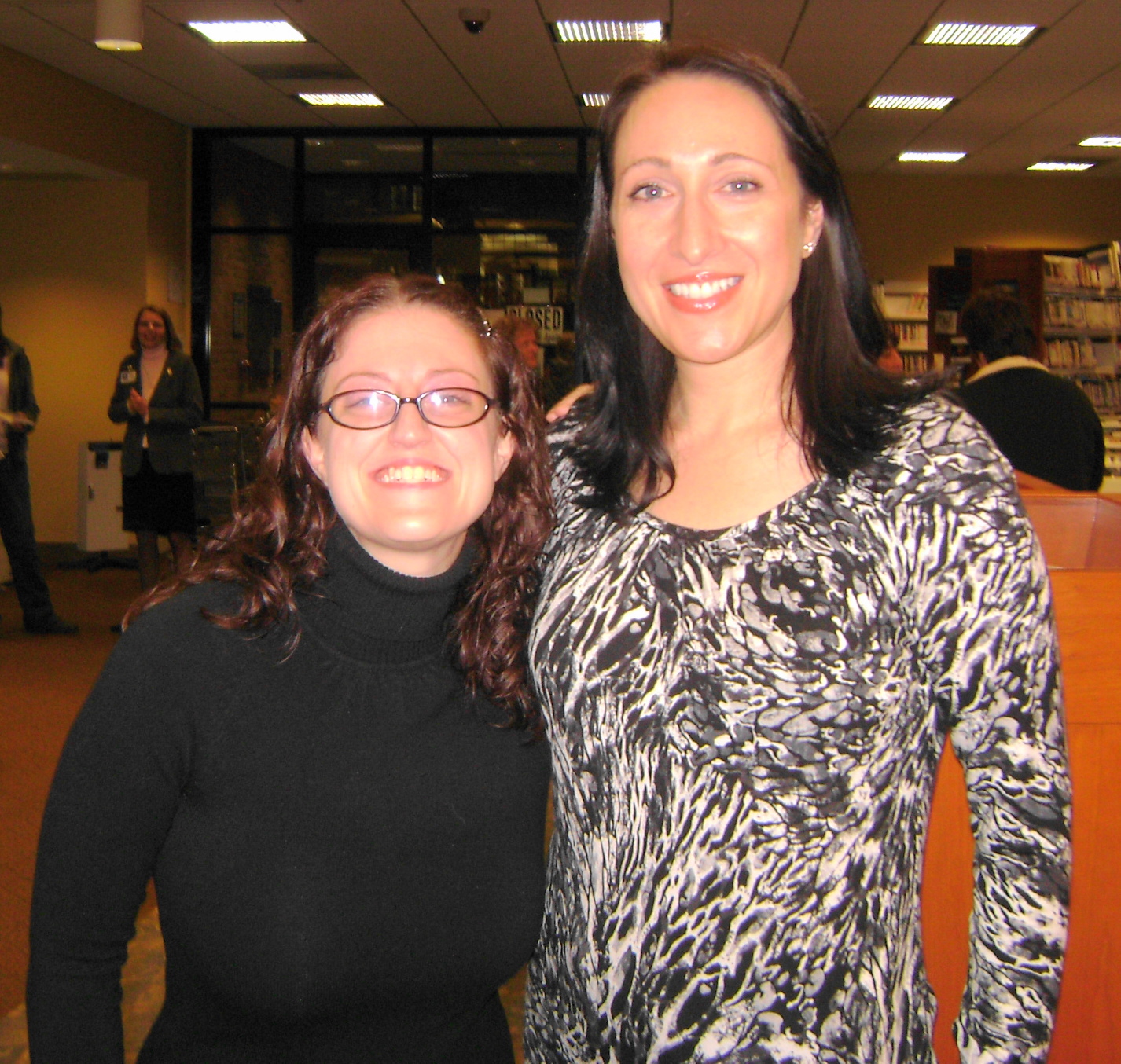
Earlier this year I had the pleasure of meeting New York Times bestselling author Taylor Stevens, a thriller writer, and one of my favorites. She visited the Brecksville branch of the Cuyahoga County Public Library, did a Q&A and signed copies of her first book in the Vanessa Michael Munroe series, The Informationist, and the second book, The Innocent. The third novel, with the working title The Doll, is due out next year from Crown.

I spoke with Taylor via phone when The Informationist was published, and met her in person for the first time at the library. I’m also pleased to tell you the interview is now available to download via The Writing Show.

I met Taylor Stevens at the Brecksville Branch of the Cuyahoga County Library

If you enjoy thrillers, you will love this series. I devoured The Informationist and The Innocent gripped me even more. Stevens has a masterful way of weaving words to move the story forward and also make you feel like you’re in Argentina, right alongside Munroe as she works undercover to infiltrate a religious cult to rescue her friend’s daughter, Hannah.

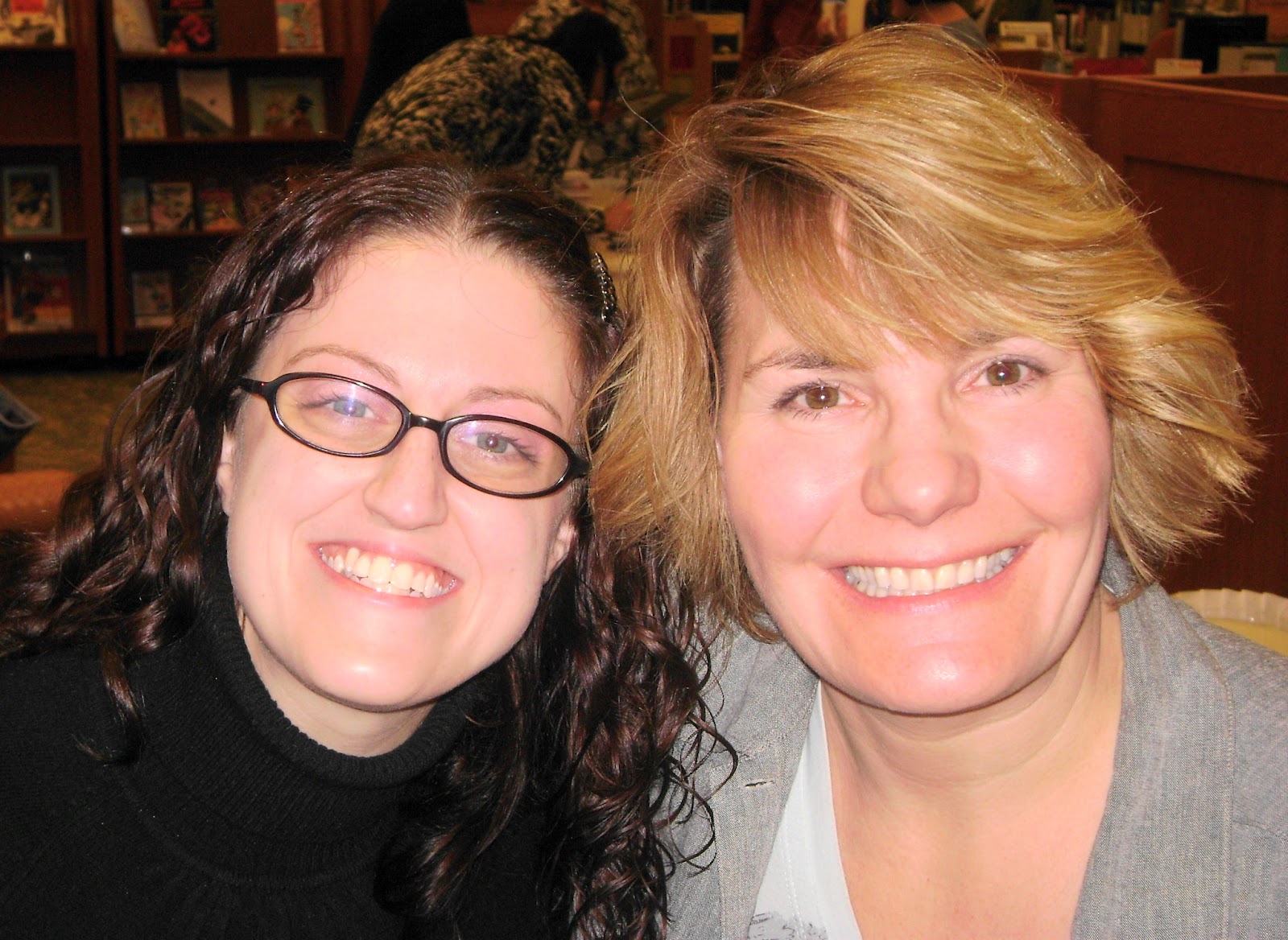
A special thanks to our mutual friend Kim Urig for introducing us.

Kim Urig (right) and me

How to Stay Focused Online


Guest post by Lauren Bailey

Like many writers, I need to be able to research topics quickly to sound the least bit convincing that I have any idea what I’m saying. This research relies heavily on the Internet, which as you may know, is filled with endless mountains of distraction.

I used to look down on those stay-focused-and-block-you-from-distracting-sites web applications and the people who used them, thinking, “How about you just learn some self-control.” But that was before I fully realized the time-wasting beauty that is Reddit. Since then, I’ve come to appreciate these time-management apps. In fact, one of the main reasons I’m writing this post as opposed to surfing YouTube is because my browser blocked me from those sites after I reached my time-wasting quota of the day.
 
StayFocusdFor Chrome
I use the Google Chrome browser for most of my Internet needs. While Chrome didn’t always allow extensions or addons (as Firefox calls them) to their browser, the browser is now equipped with a full arsenal of extensions. StayFocusd is the extension designed to limit the amount of time you waste on the Internet at unproductive websites.
It works by allowing you to select which sites you wish to block; you can type in URLs manually or select popular sites from their list. You can also add sites to the list while you’re surfing the web with the browser extension button. The button turns red when you’re visiting a blocked site.
By now you may be a little confused, thinking, “Isn’t this supposed to block me from distracting sites?” The beauty of StayFocusd is that it blocks sites on your terms. You give the extension a “Maximum Time Allowed Per Day” value that sets the maximum time you can spend on all of your blocked sites combined. You can also specify StayFocusd to only actively restrict your blocked websites on certain days and/or hours of the day.
Let’s say you need to get some work done right now even though you haven’t exceeded your “Maximum Time Allowed.” Thankfully StayFocusd gives you “The Nuclear Option” which lets you block sites for the number of hours you indicate. If I know I need to get some work done in the next three hours, I’ll “Nuke” my time-wasting sites so that I have less distractions preventing me from getting things done.
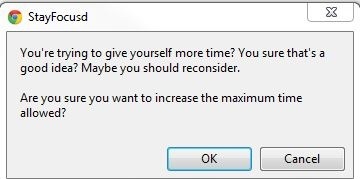
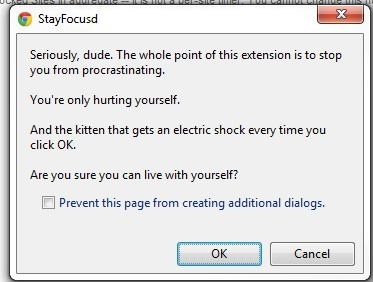
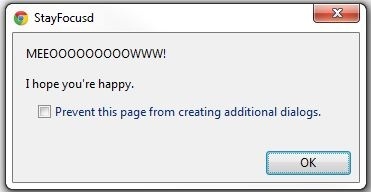
One awesome/cute aspect of the web application is that it knows whether you are trying to “hack” it when you change settings. For instance, if I try to raise my “Maximum Time Allowed Per Day,” StayFocusd will prompt a series of dialogue boxes with the following:

(You get the idea.)
LeechBlockfor Firefox
For those of you dedicated to surfing the web with Firefox, fear not because you have quite a powerful anti-time-wasting addon at your disposal. In fact, I would say LeechBlock gives you more options in terms of customizing which sites you want to block when.
Like StayFocusd, LeechBlock allows you to specify which days and at what time you would like to limit your time-wasting sites. LeechBlock also lets you set a time limit for how long you can surf your blocked sites before they are blocked for the day.
In addition to all these features though, LeechBlock also gives you six different “Sets” of sites in which you can make different parameters for different sites or time periods. So if I plan to work every Monday through Friday, 9 a.m. to 5 p.m., I will create one Block Set that might completely limit my time-wasting sites. After 5 p.m., I give myself more time to waste. Deep down I still know I have some personal projects to finish, so I create another Block Set for after 5 p.m., but it allows me to surf my time-wasting sites for three hours.
This also allows you to dictate more strict blocks on certain sites. My Google Reader page can actually help my research process or career path, so maybe I will allow myself to use that site five hours a day. Facebook, on the other hand, I think I will limit to only an hour a day.
Bottom Line
Both of these web applications can serve you well, provided you are honest about which sites you actually waste your time on. So it really all comes down to which browser you prefer. Also, I realize that you can easily “hack” either of these extensions by simply surfing on another browser, but honestly I think the strength of these applications is that they set visible benchmarks that allow you to see how much time you spend (and waste) on certain websites.
Sure, a much more top-down approach would be to simply prioritize the things that you really need to do in a reliable system which consistently reminds you of these priorities until they are completed. In other words, it would be more ideal to focus on the tasks at hand rather than focus on how to limit distractions away from those tasks. After all, distractions are often self-fulfilling desires stemming from a lack of motivation. At least that’s what they said before the Internet. Now that the Internet is around and everywhere though, I’m going to stick with StayFocusd to help me get things done.
 

By-line:
This guest post is contributed by Lauren Bailey, who regularly writes for best online colleges. She welcomes your comments at her email Id: blauren99 @gmail.com.

Seven Questions for Jessica Kristie

Welcome to the next installment of The Seven Questions Series. Thanks to Jessica Kristie for being my guest!

The Background
 

“Poetry is my heart, anchors my soul and documents my journey.” – Jessica Kristie

Born and raised in the California Bay Area, Jessica discovered her passion to write at the young age of ten. She regurgitates her heart and mind, sometimes in structure and sometimes in free flow, as a way to heal and understand herself and those around her.

Jessica’s inspiration comes in many forms, often inspired by just a word or quickly fleeting emotion.  Through years of writing she has been able to capitalize on her experiences, whether they are painful or joyous. Inside each of these moments lies a grand piece of her history. They are a documentation of much of the pain life has to offer, and the hopeful bit of empowerment required for survival. She hopes to draw you close to her world through shared emotion while inspiring you to forgive, remember, and heal.

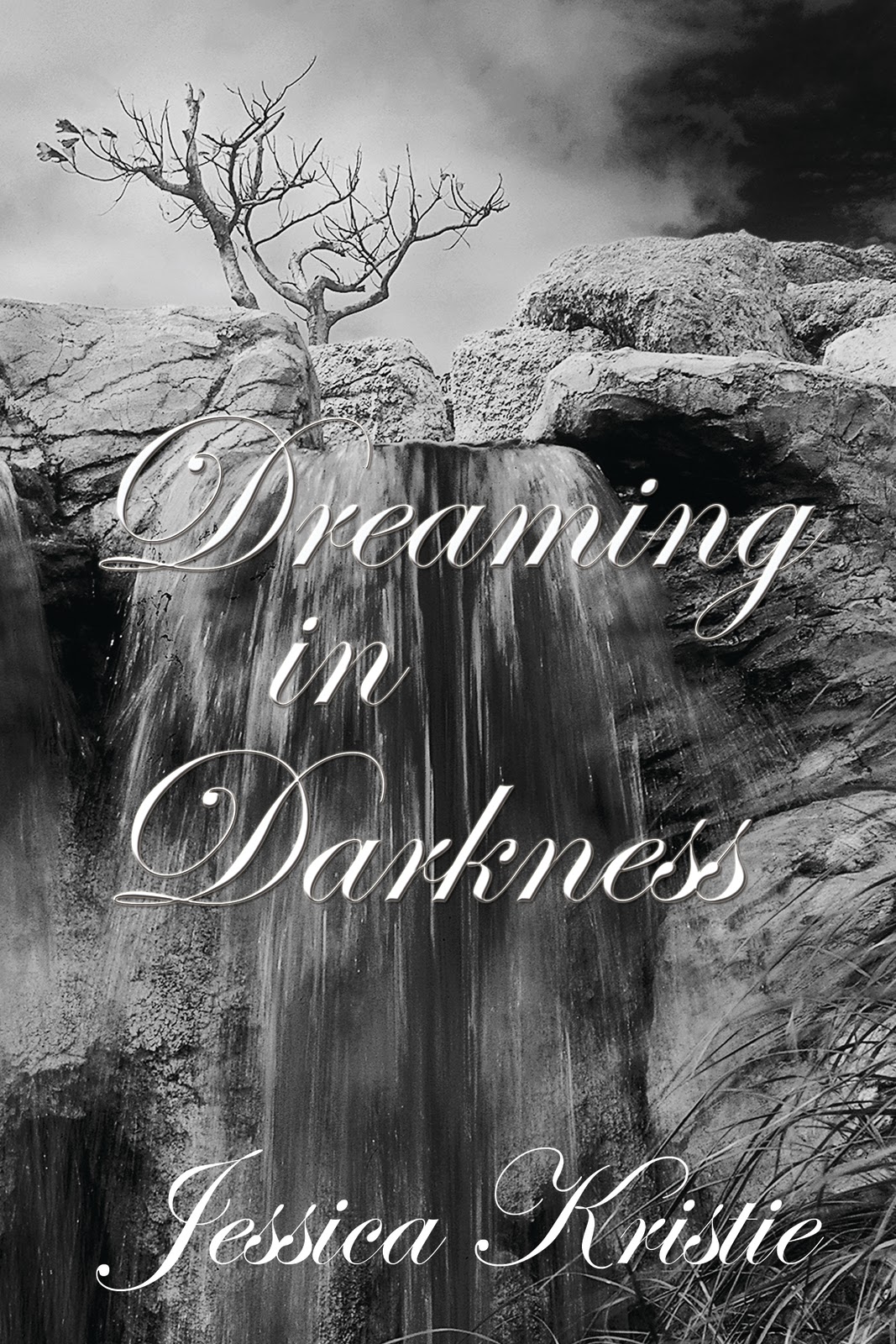
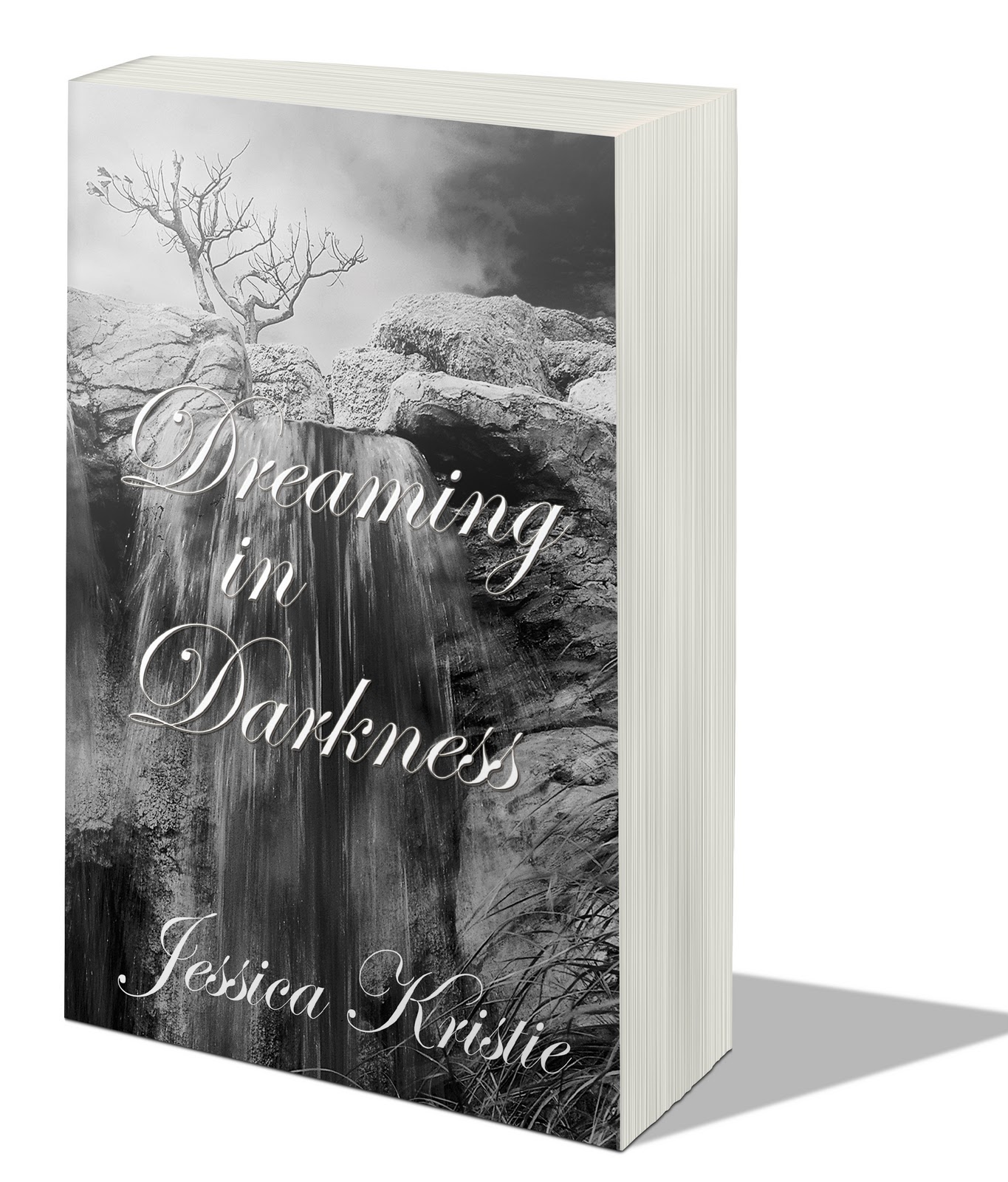
You can find Jessica’s first volume of poetry and prose Dreaming in Darkness at Winter Goose Publishing. She has several other projects in the works including a second book of poetry and her first novel.  You can follow her at JessicaKristie.com for updated information.

 
Connect with Jessica
Twitter: @jesskristie
The Review


When I first began writing at the tender age of about 12, I wrote poems. Some very bad poems. Over the years, as I explored fiction in the form of flash fiction, short stories and novels, I wrote an occasional poem. About five years ago I attempted to write a nature poem. I took it to a critique group, edited it, sent it to a poetry contest, received a kind rejection letter.
Since becoming hooked on nonfiction writing, I haven’t written any poems, but I still love to read poetry. I admire poets because it’s nowhere near as easy as it looks to write a poem. It’s hard work and craft and just as much editing as any other form or writing, if not more because the language in a poem is so much more precise.
I love to read poetry because I find it inspiring, especially when I’m stuck. To read poetry is to free and loosen up your mind. A writing exercise I’ve tried (courtesy of Natalie Goldberg) is to take a line of poetry and use it to start a timed writing session. It’s a terrific technique to get yourself going. I’ve also read in several places that it’s helpful to read some poetry before you start writing.
Poetry is pretty. Poetry is fascinating. Poetry makes you think and reflect.
Jessica Kristie’s Dreaming in Darkness made me remember all the reasons I love poetry. Her poems are gorgeous snapshots of emotion, some of it quite painful, but she leaves room for healing, love and forgiveness, and I finished her collection with a sense of hope.
I’m also a huge fan of prose poetry and loved the prose poems in the last section of her book, “Moments – Prose Poetry.” The first poem in the book, “Behind my Breath,” felt like a punch in the stomach that makes it hard to breathe for a minute. I could not believe how much I related to it, and I read it over and over, so amazed was I at how perfectly Jessica’s words described my situation. I think that’s the best part about poetry. The poet writes from his/her vantage point, and the reader reads from an entirely different vantage point and it resonates because of the universal theme from the poem.
I love this poem so much I asked Jessica if I could share it in this post, and she kindly said yes.
Behind My Breath
You wait on “Sorry,”
I wait on Forgiveness.
Bruised and broken,
changed and forgotten.
Yet between this truth and past despair,
there is a space that isn’t there.
Behind my breath
and within your grasp,
where you cover and heal,
eternal forgiveness – is real.
Still this blank page, words won’t fill.
Beyond my faith, pain stand still.
I wait on “Sorry,”
you wait on Forgiveness.
Out of these ashes
and out of this pain,
I will pull myself from the wreckage,
I left myself in.
I let you in,
to be what I am not,
to fix what I have broken –
find what I have lost.
But I no longer wait.
I am moving past and beyond,
through your spirit,
and your healing song.
You
are perfection.
What I strive to be.
That perfect grace note,
sung within me.
Dreaming in Darkness
COPYRIGHT © 2011 by Jessica Kristie
Excerpt appears courtesy of Winter Goose Publishing
 
I highly recommend this book for your poetry library, or as a gift for the poetry-lover in your life (today is Black Friday, after all, and the kick-off to the holiday shopping season). It’s available in paperback and as an e-book.
 
The Seven Questions


The Chipper Writer: Tell us how you came to be a poet.
 
Jessica Kristie: I believe school helped me discover the wonders of poetry and writing. Poetry immediately caught my attention at the age of 10, when I wrote my first piece. Ever since then, poetry has worked as a place to lay my emotions down and a healer for many aspects of my life. Poetry creates a greater understanding of the human condition and gives me different eyes to see with.
 
TCW: Tell us a little bit about Dreaming in Darkness and what inspired you to write it.
JK: Dreaming in Darkness is my first collection of poetry and is not subject to any one theme. It contains work of mine from the last four or five years. The book covers every facet of human emotion, and I believe every reader will be able to relate and take away something from it.
 
TCW: I enjoyed the prose poetry section of your book. Can you talk a little bit about prose poetry and how it differs from the other poems in your book? 
 
JK: My prose poetry falls under a different form that relates more with a Spoken Word style. It is poetic verse that reads as less of a poem form than most people might be familiar with. Each piece is followed by a standard poem. This style came to me about a year and a half ago with my first piece “Remembering Closure” (which is in Dreaming in Darkness), and it changed me. I really enjoyed writing in this way and it has really allowed me to hone my skills as a writer and a poet.
 
TCW: Can you walk us through your poetry writing process?
 
JK: The need to write bubbles up in me and I have to get it out. I carry a pen and paper wherever I go and write down words and phrases that inspire me. I rarely force myself to write, and work hard at building my inspiration through all interactions and things around me. Every day I listen for things that may strike me, and always take time to write them down. When I write, I just let it go. I go back and edit as well as let each piece sit for at least a day. I always try to have another set of eyes take a look at my work that I want to post publicly.
TCW: What is your writing schedule like?
JK: My writing schedule is not set, but I do make time for it always. I write all day and whenever the need arises. I have been blessed the last year to put most of my time and heart into writing. It is amazing how much more you learn and become polished once you have the opportunity to put serious time into it.
 
TCW: What are you working on now?
 
JK: My second book is being queried as we speak to several publishers and I am half-way through my first novel. I am also working on a collaborative book with a fantastic poet and have several other projects in the works. You can always check my blog JessicaKristie.com for updates and fresh poetry and prose.
 
TCW: What advice would you give to aspiring poets?
JK: Try many different forms and ways to write your poetry. Don’t get stuck on the technical stuff, and just write. You will find the way that really flows with your creative spirit and then you can hone that skill. Know your weaknesses and your strengths. You have to be able to take constructive criticism as a poet or any sort of writer. If you are unable to hear what others have to say, then you will never grow. Sometimes it stings, but you must listen. Don’t always take it to heart, but always listen. You may hear something that helps you become the fantastic writer you always knew you were.

An Innovative Way To Edit Your Writing

Guest post by Mariana Ashley

I’ve known a lot of different writers in my day. Hundreds of them actually, from all different writing backgrounds including short fiction, poetry, screenplay, playwriting, academic research, journalism, entertainment review and of course, blogging. Of all these different writing backgrounds, I’ve noticed one universal truth: Writers don’t like editing.

Allow me to clarify. All the good writers realize the value of editing and force themselves to do it. I have also come to the realization that many of the writers I know who do like editing are actually not that good at it. These writers tend to think of editing as quick and easy. Editing, if actually effective, is never quick and easy.

However, there are some aspects and methods of editing that are more enjoyable (or at least less boring) than others. Let’s quickly go over some of the more conventional editing methods:

• Take a Break. Writers will often go immediately into editing as soon as they’ve finished writing. Take some time to get some distance from your writing, and then your mistakes and errors will become that much more apparent. This will also give you time to rethink the goals of your writing, as these can often morph or become lost in the writing process.

• Close Reading. Every piece of writing should receive at least one close reading before any other eyes see it. While close reading, you may spot grammar errors, misspellings, and sentences or plot points that simply don’t make sense.

• Quick Reading. This can actually be extremely effective and is surprisingly underused. A quick read through a draft will get you to question more of the obvious, structural elements of your work as opposed to gritty details. Did you really need to dedicate those few paragraphs to that character? Is there any part of the narrative that’s completely underdeveloped? A quick read will point things like this out quickly.

• Read Aloud. This is one of the most effective ways for me to not only find mistakes but also find awkward phrasings. Great for proofreading.

• Change Document Formatting. You’d be surprised how changing the document formatting (font, spacing, color) will give you more of a fresh perspective when you edit. It’s an effective psychological way of distancing yourself from your first draft.

• Outline. A great way of determining whether your paper has optimal structure, outlining is extremely valuable both pre-writing and in the editing process. You can outline on your document itself by just segmenting different chunks of your writing and labeling them.

When the Conventional Methods Just Aren’t Doing it for You

As great as the methods listed above are, sometimes they still don’t give your writing the change and modifications it needs. I find this tends to happen mostly because of structural or thematic issues. Essentially, your writing is not hitting the meat of an issue it set out to examine or your writing is ordered in a strange way that undermines the purpose of the work.

This proposed method is an extension of outlining your writing, so be sure to outline your work if you haven’t already. Once your writing is outlined as you see fit, find some notecards, and write each segment of the outline on a separate notecard. Now shuffle them.

While this restructuring is random at first, it will immediately give you ideas as to which order of ideas in your writing is better than others. It’s hard to just look at an outline and decide what the best structure should be. Shuffling is a more hands-on approach that allows you to find the best structure through process of elimination and inductive reasoning.

You may also realize that your outline should be more or less detailed. Making a second or third outline is absolutely wonderful for this editing method. It allows you to base re-structuring on whatever components you see fit (ideas, evidence, plot, character introduction). Best of all, this type of editing, while time consuming, is also very fun and exciting. With this editing method, you can literally see a dead work of writing come to life.

By-line:

Mariana Ashley is a freelance writer who particularly enjoys writing about online colleges. She loves receiving reader feedback, which can be directed to mariana.ashley031@gmail.com.

Photo credit: Jakub Krechowicz

Seven Questions for Steve Sears

Welcome to another installment of The Seven Questions Series! A huge thank you to Steve Sears for being my guest.

The Background
Bio: Steve Sears, owner of SGSWrite LLC, is a full-time freelance writer living in Bloomfield, New Jersey. A freelance writer since 1996, he writes food and dining, bridal and business profiles, has published fiction and poetry, reviews books, and also does commercial writing. He guest and ghost blogs often and maintains his own blog which can be accessed via his website, www.SGSWrite.com. This September, he will be married for 24 years to his beautiful wife, Lucille. Their daughter, 20-year-old Stefanie, is a part-time freelance writer.
The Review
Steve Sears’ blog at SGSWrite.com will make you hungry. One of his specialties, after all, is food writing, and the way he writes about food is exquisite. You can see, smell and taste the food he writes about, along with feeling the ambiance of the restaraunts he describes, no matter where you live.
The blog focuses on four categories: Food and Dining, Freelance Writing, Health and Musings. A large portion of the Musings category are posts called “Saturday Thoughts,” profound and deeply moving ruminations on life, family and writing.
“I do know this,” Sears writes in “Saturday Thoughts: Desicions, Desicions.” “At my funeral, no one will say that my music died inside of me.”
One of the hard parts about writing, I think, is not letting our dreams die inside of us, since writers hear often from all over, how hard it is to be a writer. How hard it is to make a living. At times we want to give up and do things that are practical, that will make us steady sure money, that aren’t silly pipe dreams. But those things are also unfulfilling and not really who we are anyway. Steve Sears is proof that you can achive your writing goals and make a living. His blog chronicles his journey and remindes us all to not let the music die inside of us.
The Seven Questions
The Chipper Writer: Tell us how you got started as a freelance writer, and how you made the leap into full-time freelance writing.
Steve Sears: That’s a very good question. I always enjoyed writing, was encouraged in both grade school and high school to be a writer, and wrote sports columns for the local weekly while writing for my high school paper. However, it was after I began a 23-year computer operations career that I realized how bored I was doing something that “was necessary.” Then, back in 1996, I had a heart attack at the age of 34. From my hospital bed, I vowed to one day be a full-time freelance writer, and I started as a part-timer during my disability, and worked like that until 2010. I eventually moved to full-time in 2010 when my company outsourced my weekend work to Pune, India, and were prepared to put me on a work schedule I didn’t approve of. I felt the time was right.
The Chipper Writer: What is your writing schedule typically like, and can you talk a little about how you manage your time?
SS: Sure. Every day I work from a to-do list that I create the prior evening. I normally work from 7:30 a.m. – 5 p.m., and my day is a combination of working on current assignments (writing articles or conducting interviews) and marketing. I’ll normally start the day with articles, have lunch, do my marketing (which my wife, Lucille, helps me with by creating lists from jobs sites), and then finish up with more articles and creating the next day’s schedule. I carefully plan everything so that I am never bored. Boredom, to me, is a freelancer’s #1 enemy.
The Chipper Writer: What is the most important thing a new freelancer can learn?
SS: Two things, really: responsibility and to treat your freelancing as a business. My wife Lucille recently said to me, “I feel bad for you, working all by yourself down in the cellar like that.”
I responded, “I appreciate that, but why? This is the life I chose.”
I chose what I’m doing for a living, love it, and I claim 100% responsibility for it. I don’t blame externals, and when the roof caves in (and it won’t), it’s on me. Also, it’s one thing to be a hobbyist, quite another to “put your awning out” and shout that you’re open for business. This isn’t an easy thing to do – and I can certainly vouch for that. It’s no game, it’s work – and that includes marketing, networking, paying taxes and your own health insurance in addition to writing — and you have to treat it as such. Also, focus on the type of writing you’d like to do, and read the advice from others who are making a true go of it.
The Chipper Writer: What advice can you give to writers as far as writing query letters?

SS: Two things: read the magazine, and be professional in your email. That means a properly constructed query letter, detailing why you are the writer for the piece, and what you’ll offer. Also, make sure you have a proper editor’s name to forward the query to, so that it winds up in the proper email box or desk. But most of all, make sure you “know” the publication. 

The Chipper Writer: I enjoyed your blog post called “The Benefit of a Writers Group.” Can you talk a little about those benefits?

SS: Absolutely. I belong to two writers groups, one which is goal oriented with book and magazine authors, the other with budding novelists and fiction writers. We don’t necessarily share work at these meetings, but get together to discuss our writing lives. Even though I can perhaps more relate to the first group than the latter, all the folks in both of my groups are valuable to me. As a full-time writer, you NEED to be among people, especially other writers, occasionally. So, these groups are my escape, but also a well of inspiration. I may benefit from the professional knowledge of the first group, but the folks in the second group (who, by the way, are much better fiction writers than me) also give me advice I seek when I may be at a dead end. In the end, it ties in to my belief that you can be inspired by anyone at anytime anywhere, and nowhere – with the exception of my wife and daughter – do I feel that more than when I get together with my writers groups.

The Chipper Writer: You work on your taxes on the second and fourth Saturday of each month to stay ahead. What are some reasons to do your taxes this way?

SS: One of the things I least like to do is figure out my taxes and pay them, but rather than put off until tomorrow what I can do today, I break it down. I do it on a Saturday because Saturday is primarily a laid back day (blogging, update resume and website, PC maintenance, etc.), and keeping ahead of it makes it less “painless” to do when it comes quarterly tax time. The key here is to make things easier. There’s enough work to do with the writing.

The Chipper Writer: What books and other resources would you recommend to aspiring freelancers?

SS: There are many excellent ones, but here are a few I always reach for when need be. Kelly James-Enger’s $ix-Figure Freelancing is excellent, as is her Ready, Aim, Specialize! Kelly’s blog, Dollars and Deadlines, is also valuable. Also, I recommend Linda Formichelli and Diana Burrell’s The Renegade Writer book and companion blog. What a wonderful wealth of information. If you’re seeking a copywriting career, Peter Bowerman’s The Well-Fed Writer, as well as his blog and newsletter, are super. Finally, read The Writer magazine. There’s something for someone in every issue.


Lost Your Muse? Five Easy Ways to Find Inspiration

Guest post by Alvina Lopez

Whether you’re a blogger, journalist or a fiction writer, you’ll have to deal with the dreaded phenomena of “writer’s block” at least once in your career. There are some simple ways to find that inspiration you need to remove the road blocks and continue (or start) writing. To learn the five easy ways to find inspiration, continue reading below.

Free Write. By far one of the easiest ways to get those creative juices flowing is to just start writing. Anything. It doesn’t matter what it’s about. Just grab a piece of paper and start writing whatever comes to your mind—don’t over think, don’t edit and most importantly don’t stop. Just write. Sure, your finished project will probably be filled with a bunch of unusable junk, but you might just end up with a gem—or at least a few note worthy lines.

Listen to Classical Music. This might sound silly, but some studies show that listening to classical music can actually help stimulate different parts of the brain that can help one retain more information and think more creatively. While the correlation between Mozart and the creativity process isn’t proven to be 100 percent true, music can undoubtedly have a soothing effect and can change one’s mood—this fact alone can help you relax, enabling you to embrace a flood of inspiration. But if classical music doesn’t really do it for you, at least try some other soothing music genres such as trance or jazz.

Get out of Comfort Zone. Locking yourself up in a quiet room and forcing yourself to come up with an idea is one of the worst things you can possibly do. Instead, unglue yourself from your desk chair and get out. Go somewhere that is unfamiliar territory to you or someplace that you normally don’t hang out and see if anything inspires you. While you may want to choose a place that’s secluded so that you can gather your thoughts, sometimes it’s best to go to areas that are typically crowded, such as the park, a coffee shop or the airport. This is because crowded areas are great places to eavesdrop and “people watch”. You don’t want to be a creeper about it, but sometimes things you hear or see from unsuspecting sources can make some of the best dialogue or topics.

Turn to the Pros. Another great way to get rid of writer’s block is to read or watch material that you find to be exceptionally well written or clever—something you’d like to mimic or could create some sort of spin off. This can include anything from reading books, blogs, magazines, and newspapers or even watching movies. Whatever you choose, just make sure you’re paying close attention to themes, writing style, voice, dialogue and rhythm.

Sleep. Lastly, while this may not have crossed your mind, sometimes just getting a good night’s rest is all you need to clear your head and feel inspired. Sometimes your mind is so overworked that it can’t think anymore, but getting sleep allows your brain to rejuvenate and build more brain cells that can help you think more clearly. Always make sure you have a notebook by your bedside table too—you never know when a dream will “speak to you.”

By-line:

Alvina Lopez is a freelance writer and blog junkie, who blogs about accredited online colleges. She welcomes your comments at her email Id: alvina.lopez @gmail.com.

Photo Credit: stock.xchange.com